A cooling tower can meet its design flow and temperature and still use more energy than it needs, recirculate its own hot air or complicate every maintenance shutdown. Very often, the cause lies in a decision made at the start of the project: where the fan is placed.
In an induced draft cooling tower, the fan sits at the top and draws air through the fill. In a forced draft cooling tower, it sits at the base and pushes air into the tower. That difference determines energy consumption, recirculation, noise and access to the mechanical equipment throughout the tower’s service life.
At Torraval we have been manufacturing both configurations for more than 55 years, and we know that neither is better in absolute terms. This article explains how they differ and how to choose the right one for each process. The full classification is available in our article on types of cooling towers.
What is an induced draft cooling tower
An induced draft cooling tower is a mechanical draft tower in which the fan, usually axial, is installed at the top discharge. As it turns, it creates a low-pressure zone inside the tower that draws in outside air. The air enters through the side or lower inlets, passes through the fill where the water is cooled, and is discharged vertically through the top.
In this configuration, the specific components are concentrated in the upper part of the tower. That is where the fan and its drive are located, which may include an electric motor, gearbox and drive shaft. Just upstream of the fan sits the drift eliminator, which captures the water carried away by the airflow. The remaining components are described in our guide to cooling tower components and materials.
Crossflow and counterflow induced draft
An induced draft tower can work with two airflow configurations:
- Counterflow: the air rises in the opposite direction to the water, which falls from a spray distribution system.
- Crossflow: the air passes horizontally through the fill while the water falls vertically, usually distributed by gravity from hot water basins at the top.
What is a forced draft cooling tower
A forced draft cooling tower is a mechanical draft tower in which the fan, axial or centrifugal, is installed at the base, at the air inlet. It pushes air into the tower, forces it upwards through the fill and discharges it through the top. Because it handles dry inlet air, the fan and its drive remain outside the flow of hot, humid air.
Forced draft towers are usually built in a counterflow configuration. With centrifugal fans they can handle external static pressure, which allows them to be installed indoors or with inlet and discharge ducts. Torraval has been designing forced draft towers since 1967 for sectors such as steelmaking, the paper industry and the food industry, as we explain in forced draft cooling towers.
Difference between induced draft and forced draft
The difference between induced draft and forced draft lies in the position of the fan. In induced draft, the fan is at the top and extracts the hot, humid air. In forced draft, it is at the base and pushes dry air into the fill. That position determines fan consumption, the risk of recirculation, noise and access to the mechanical equipment.
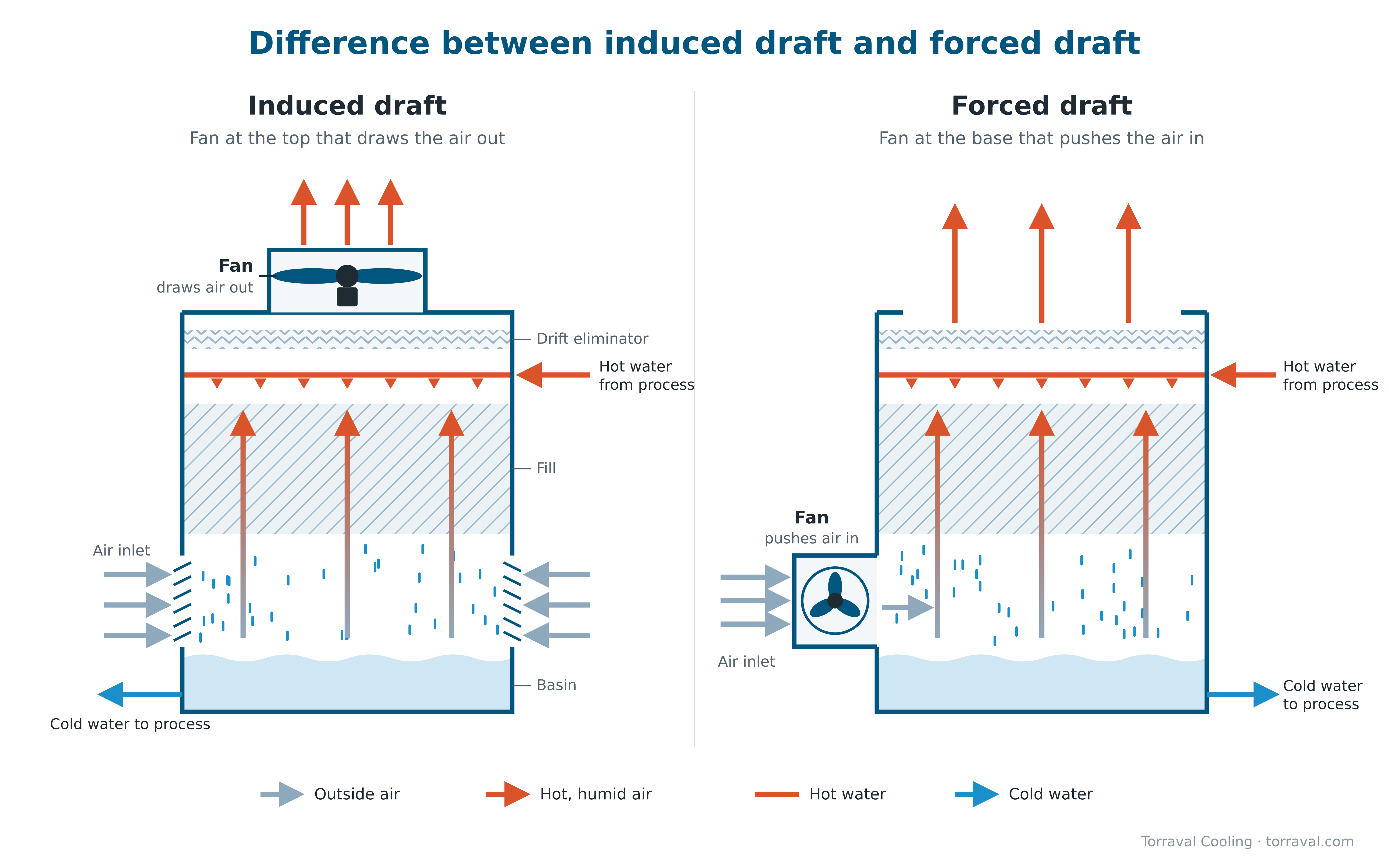
| Criterion | Induced draft | Forced draft |
|---|---|---|
| Fan position | Top, at the discharge | Bottom, at the air inlet |
| Air handled by the fan | Hot, saturated air | Dry inlet air |
| Typical fans | Axial | Axial or centrifugal |
| Airflow configuration | Counterflow or crossflow | Usually counterflow |
| Recirculation risk | Lower | Higher, due to lower discharge velocity |
| Fan consumption | Generally lower | Generally higher, especially with centrifugal fans |
| Noise | Emitted from the top | Concentrated in one direction, easy to screen |
| Access to mechanical equipment | At height | From the base |
Advantages and disadvantages of induced draft and forced draft
Neither configuration is superior in every respect. Induced draft wins on energy consumption and recirculation control. Forced draft wins on protection of the mechanical equipment, noise control and ease of maintenance. The choice depends on what matters most in each installation.
Induced draft
It has three advantages:
- Lower fan consumption.
- More uniform air distribution across the fill.
- Lower risk of recirculation, thanks to the vertical discharge at higher velocity.
It has two disadvantages. The fan operates in the saturated airstream, which requires corrosion-resistant materials. And the mechanical equipment is located at height, which calls for platforms and safe access for every inspection.
Forced draft
It has four advantages:
- Less wear on the mechanical equipment, because the fan handles dry air.
- Noise concentrated in a single direction, which makes it easier to install acoustic screens.
- Access to the fan and motor from the base, without work at height.
- Option to install indoors or with ducts, when fitted with centrifugal fans.
It has two disadvantages. The fan usually requires more power, especially if it is centrifugal. And the lower discharge velocity increases the risk of recirculation, that is, of hot exhaust air re-entering through the air inlets. This is why location is particularly important, as we explain in cooling tower location.
The difference in consumption can be reduced by regulating the fan:
- Torraval Control System (TCS): adjusts fan speed according to ambient temperature. In the renovation of a forced draft tower in Cantabria, it delivers energy savings of up to 20%.
- Permanent magnet motors: can reduce consumption by up to 30% compared with conventional motors, and also eliminate the need for gearboxes and transmissions.
When to choose each configuration
An induced draft cooling tower is usually the right fit when the priority is energy consumption and thermal performance, especially on open sites where the vertical discharge disperses without interference. Forced draft is the natural choice in aggressive environments, where there are acoustic constraints, or when the mechanical equipment needs to be accessible from the base. In both cases, the decision is part of sizing the installation.
Torraval’s forced draft CTFP series is designed for demanding industries such as steelmaking and paper. Eleven CTFP towers serve the Atlantic Copper metallurgical complex in Huelva. In Cantabria, a customer replaced its forced draft tower, installed in 1993, with a CTFP using the same technology.
Regardless of the draft type, multi-cell installations add operational flexibility:
- Gijón: at a steel plant, cell isolation allows production to continue during maintenance.
- Seville: at an olive processing plant, a tower with two independent basins, one per cell, and two variable speed drives cools two different processes separately.
The draft type is decided together with the flow rate, thermal load, water quality and wet bulb temperature, as we detail in our guide to cooling tower sizing.
Frequently asked questions about induced draft and forced draft
What does induced draft mean?
Induced draft means that the cooling tower fan is located at the top discharge and draws air through the fill, rather than pushing it in from the inlet. The fan creates a low-pressure zone inside the tower, which pulls outside air in through the side or lower inlets. It is one of the two mechanical draft arrangements, together with forced draft. It can be combined with crossflow or counterflow.
What is the difference between induced draft and forced draft?
The difference lies in the position of the fan. In induced draft it is at the top and extracts the hot, humid air. In forced draft it is at the base and pushes dry air into the fill. Induced draft usually consumes less energy and has a lower risk of recirculation. Forced draft better protects the mechanical equipment from moisture, concentrates noise in one direction and makes maintenance easier from the base.
What is the difference between forced draft and natural draft?
Forced draft uses fans to move air through the tower. Natural draft has no fans: the air flows due to the density difference between the warm air inside and the outside air, thanks to a large chimney. According to the technical guide of the Spanish Ministry of Health (in Spanish), natural draft towers are used almost exclusively in large industries and power generation plants, which need to cool very high water flows.
What is recirculation in a cooling tower?
Recirculation is the re-entry of hot, humid discharge air through the tower’s own air inlets. It raises the temperature of the air entering the fill and reduces the thermal performance of the equipment. Induced draft towers have a lower risk because they discharge air vertically at higher velocity. In any tower, location is decisive: the distance to walls, buildings and nearby structures must allow the exhaust air to disperse.
A configuration defined by process data
Choosing between an induced draft and a forced draft cooling tower affects consumption, maintenance and plant integration throughout the equipment’s service life. Torraval analyses each process and site before recommending a configuration.
If you are considering a new installation or replacing an existing tower, talk to our technical team.