Evaporative condensers condense the refrigerant by evaporating a small amount of water over a tube bundle, which allows them to operate at lower condensing temperatures than an air-cooled condenser. Their five main advantages all stem from that physical principle: a condensing temperature linked to the wet-bulb temperature rather than the dry-bulb temperature, lower electricity consumption in the compressors, lower fan power, a smaller plant footprint and, with removable walls, easier maintenance. In Torraval units, this difference compared with air-cooled systems translates into energy savings of more than 10%.
Condensing temperature linked to the wet-bulb temperature
An evaporative condenser uses the wet-bulb temperature as its reference, which is the lowest temperature to which air can be cooled by evaporating water. That temperature is always equal to or lower than the dry-bulb temperature, and the difference between the two is the margin the installation gains.
The effect is greatest in the hot months. In a project for a smoked fish producer in Alicante, Torraval selected an MCE I3-23 condenser that condenses at 35 °C with a design wet-bulb temperature of 26 °C. With an outdoor dry-bulb temperature of 35 °C or higher, an air-cooled condenser cannot reach that value, because it has to condense above the temperature of the air that cools it.
Lower electricity consumption in the compressors
A lower condensing temperature reduces the discharge pressure, so the compressor needs less work to reject the same amount of heat. The compressor is the largest electricity consumer in a refrigeration installation, so every degree gained in condensing temperature shows up on the energy bill.
In Torraval evaporative condensers, this lower condensing temperature compared with air-cooled systems delivers energy savings of more than 10%.
Lower fan power
Evaporating water removes far more energy per kilogram of air than simply heating that air. An evaporative condenser therefore needs to move less airflow than a dry unit to reject the same capacity.
The MCE I3-23 unit from the project above covers the 660 kW required by the client, with a maximum capacity of 746.5 kW, and does so with 22 kW of installed power: three 5.5 kW axial fans and a 5.5 kW recirculation pump. Lower airflow also allows smaller or slower fans, which helps keep noise levels down.
Smaller plant footprint with a single unit
Heat exchange with water evaporation is more intense than dry heat exchange, so the coil required for the same capacity is smaller. The result is a compact unit, useful on rooftops and in plant rooms where space constrains the project. The MCE series covers 80 to 1,900 kW with this approach.
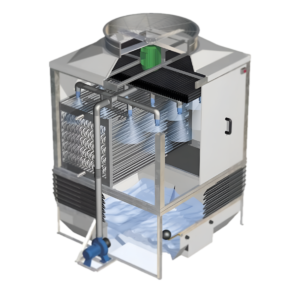
The classic alternative combines a water-cooled condenser with a cooling tower. The evaporative condenser integrates both functions in a single unit and eliminates the condenser water circuit between the two pieces of equipment, along with its pumping and pipework. In the tower-based system, heat passes first from the refrigerant to the water and then from the water to the air. In the evaporative condenser, the refrigerant condenses inside a smooth-tube coil that is kept wet on the outside by sprayed water and counterflow air, without that intermediate temperature step.
Accessible maintenance with removable walls
This advantage comes not from the technology but from the design of the unit. Many evaporative condensers are closed, and their interior can only be inspected through complex dismantling. Torraval units can be configured with up to three removable walls that give full access to the interior.
Technicians can visually inspect the coil, the basin, the water distribution system and the drift eliminator. These are the areas where scaling and corrosion begin, and detecting them early prevents performance losses and shutdowns.
Correct selection determines the outcome
All of the above has a common origin, which is condensing against the wet-bulb temperature instead of the dry-bulb temperature. That is where the compressor savings, the lower fan power and the compact size of the unit come from. The accessible design adds the ability to maintain that performance throughout the unit’s service life.
Whether that performance materialises depends on sizing the unit with the installation’s real data. At Torraval, a manufacturer with more than 55 years of experience, part of the MITA group and certified to ISO 9001 and ISO 14001, we analyse the climate, thermal load and water quality of each project before recommending a solution.
If you are defining the condensing system for a refrigeration installation, contact our technical team and we will study which unit best suits your operating conditions.